
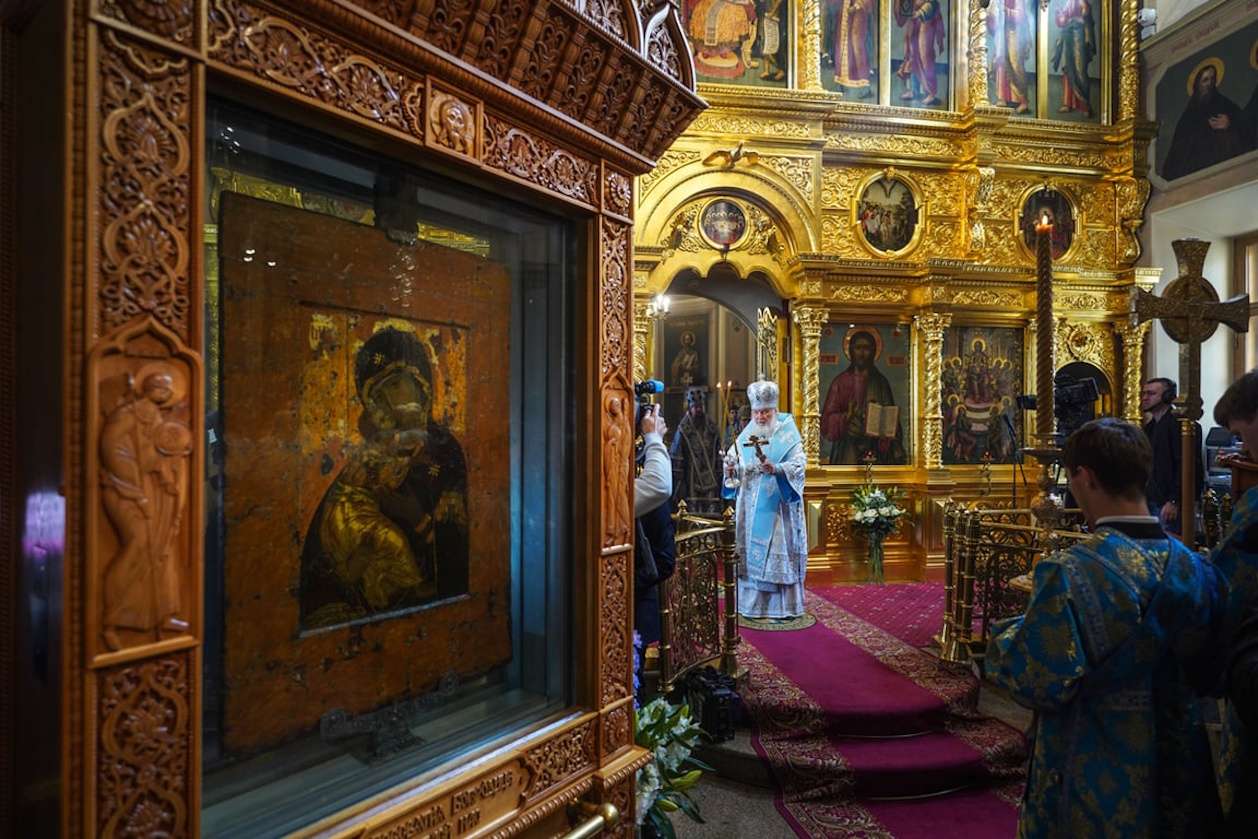
This year the State Tretyakov Gallery signed a 49-year agreement giving the Cathedral of Christ the Saviour use of two icons of the Mother of God, the Vladimir and the Don, which had been in the museum’s collection for nearly a century. St. Andrei Rublev’s Trinity had already gone the same way, to the Trinity-Sergius Lavra. Each transfer was presented as a homecoming, with the icons returning from the museum hall to the place of prayer.
In an essay just published by Public Orthodoxy, Andrei Vorobyev tells the story differently, and he writes from inside the system he describes. An art historian and curator, he was deputy director for exhibitions at the Tretyakov Gallery itself and led its major international projects in Old Russian art, Holy Russia at the Louvre among them. From 2015 to 2022 he headed the State Catalogue of the Museum Fund of the Russian Federation, and over the same years, since 2005, the Ministry of Culture relied on him as an expert on cultural property. Today he is an associate member of Eur’ORBEM, the CNRS and Sorbonne University research center for Eastern, Balkan, and Central European studies. For him the transfers mark the end of the museum chapter in the life of these holy images. Works in which sacred and artistic value coincide have become “hostages to the current Russian regime.”
Vorobyev is not arguing against prayer before the great icons. He reminds us that a workable arrangement already existed. From 1999 the Vladimir icon stood in a climate-controlled case in the Tretyakov’s own church of St. Nicholas in Tolmachi, where restorers looked after it and the faithful venerated it. He sets this beside cases that ended badly. The Bogolyubovo icon was handed to the Knyaginin Convent in Vladimir in 1992 and nearly ruined by poor storage. The Toropets icon disappeared from public view in 2009 into a church inside a gated luxury compound outside Moscow. What he asks is who can keep a panel eight or nine centuries old alive, and to what use it is being put. To the second question there is already an official answer. According to Vorobyev, Patriarch Kirill has announced a new role for the Vladimir and Don icons: to protect the Russian army in the war against Ukraine.
For a gallery of contemporary icons this is not a distant museum quarrel. We believe icons are painted to be prayed before, and we work so that new icons reach homes and parishes instead of storerooms. For that very reason, an icon turned into an instrument of state ideology troubles us more than one behind museum glass. Public Orthodoxy’s editors add a grim postscript. By the time the essay appeared, humidity in the Trinity’s case at the Lavra had reportedly climbed to around 80 percent, against a norm of 50–55. The panel began to warp, and the icon was withdrawn and replaced with a copy. Vorobyev traces, law by law and transfer by transfer, how things came to this.
Read Andrei Vorobyev, “Holy Things To Go,” on Public Orthodoxy →
